
Article, Shared Experiences, Young Onset Dementia
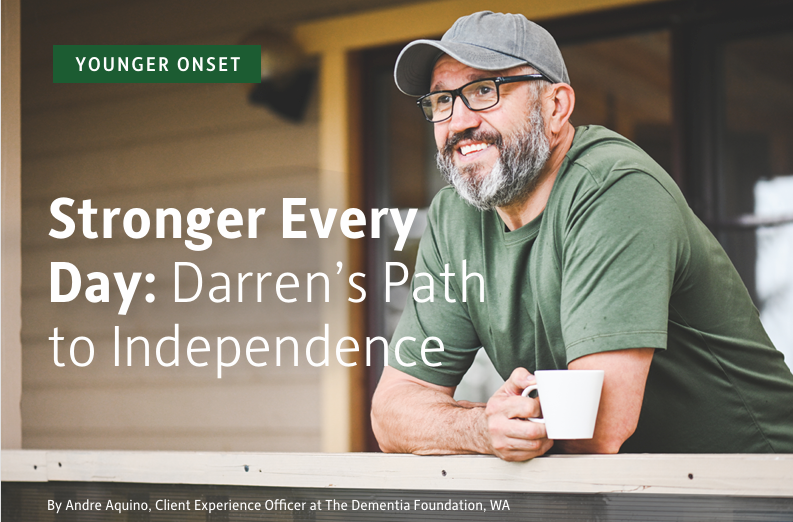
Person Centred Care: Darren’s Journey to Independence
By Andre Aquino, Client Experience Officer
“I get a lot of stuff stolen. The other day I went to sleep for 10 minutes and half my stuff was gone.”
That was what Darren (name changed for anonymity) experienced consistently after he moved from Victoria to Perth. He had left school early to work in farms and factories, but came west seeking new opportunities. He had hoped to find work and housing. Both were in short supply, and he wound up braving the streets. To add to his difficulties, he found himself struggling to recall important details or learn new information. His mind just wasn’t cooperating.
He did not know it at the time, but he was being affected by a terrible disease: young onset dementia (YOD). It would change his life and put him on a journey he is still soldiering through to this day.
Receiving a diagnosis of YOD can be difficult to navigate. Defined as any dementia wherein symptoms occur before the age of 65 (Loi et al., 2023), it impacts individuals often at a time when they are most actively pursuing hobbies, developing skills, raising families or advancing their careers (Giebel, 2022). This means that those who receive the diagnosis will have to face several challenges all at once. These include rapid breakdowns in family and social dynamics, loss of income and the inability to support themselves and their families, and severe anxiety and fear for the future. The resulting loss or perceived loss of autonomy can have an intense impact on a person’s mental health and outlook on life (Busted et al., 2020).
However, maintaining independence in the face of those challenges can lead to a new appreciation of relationships and the little things that make each day. The person centred care (PCC) approach is key to this outcome as it involves both the participant as well as their support network and families. Fostering relationships founded on openness, trust and sympathy, and building rapport are key to the implementation of PCC (Marulappa et al., 2022). The goal is to help those with a diagnosis understand that they are a valued part of their community. Their wants and needs matter. Developing a deep understanding of their goals and reconciling these against existing evidence and data allows the development of the right programs to properly support them.
While actually following through on a PCC program can be challenging both for support staff and the person with the diagnosis, the rewards for perseverance are great. It can also show that life has meaning and beauty, and that the diagnosis does not define them. This is the lesson that Darren’s story demonstrates.
A typical day with Darren
For Darren, every day is an exercise in maintaining his capabilities and control over his life. He wakes up at around 7am and has Weetbix for breakfast. He never forgets the coffee, of course. Darren loves his coffee and has it again at 11am with some fruit or muffins. This hearty combination gets him energised and ready for the day ahead.
Darren likes to keep active. Within the day he will put himself to work washing dishes, setting the table for meals, and doing the laundry and setting them out to dry. He likes things orderly, and getting involved means prompt mealtimes and a nice, predictable day. When he is outdoors, he often walks around the backyard to view the garden or just sits in a chair and basks in the sun. If he needs a change of scenery, Darren also heads out to the nearby park, which he knows well. Visiting the cafes for some more coffee and to see his community’s daily buzz is often on the agenda, too. While indoors, Darren fancies himself playing some darts. After that, he relaxes on the couch while watching the telly.
After an active day, Darren winds down as he always has. He will have a short nap most evenings before setting the table for dinner. After that, he will watch some more TV before settling in for bed.
While Darren sleeps deeply and well most nights, some past experiences have stuck with him. He will sometimes get up and wander around the house and even check in on his support workers out of concern. It takes some help, but he usually realises everything is okay and heads back to bed to start a new day the next morning.
Darren’s diagnosis and the road to empowerment
Darren’s occasional anxiety comes from his challenging past. While braving the streets of Perth, his health and wellbeing declined daily. All the while, he was beset by difficulty remembering even the most important things. His circumstances reached the point that intervention became necessary and he was admitted to hospital for care. It was then that Darren received the news: he had been diagnosed with YOD, specifically Wernicke-Korsakoff syndrome.
A combination of the acute Wernicke’s encephalopathy and the chronic Korsakoff syndrome, Wernicke-Korsakoff syndrome is the end result of severe thiamine (Vitamin B1) deficiency, typically caused by alcohol use disorder (Oudman et al., 2022). This deficiency consequently leads to cognitive and motor issues. While such a diagnosis is severe, Oudman et al. (2022) demonstrated that rehabilitation programs do exist and often recommend integration of both cognitive and motoric care. Such care is essential, as these diagnoses are usually accompanied by a strong sense of apathy and require consistent goal setting and activities in order to rebuild autonomy (Oey et al., 2020).
In Darren’s case, rehabilitation required assistance from support providers specialised in caring for those with a YOD diagnosis. Enquiries by hospital staff eventually resulted in him and his family meeting The Dementia Foundation. After back-and-forth discussions, Darren and his family decided that maintaining and rebuilding his independence and quality of life were paramount. It would take time, but there was a path forward.
Darren’s new life: lessons in PCC and evidence-based support
In order to implement PCC for Darren, it was essential to understand that his tough experiences and his diagnosis had shaped how he dealt with the world, making him feel anxious and apprehensive. While he knew of these issues and was determined to overcome them, trusting others would take time. So, The Dementia Foundation staff took it slowly. They implemented a tailored YOD program to help him achieve goals consistently without rushing him. These goals ranged from going for a walk, to setting the table, to remembering to shower at the end of the day. Darren’s confidence and capabilities grew. In time, he began to create and pursue these routines and goals with little to no prompting from support workers.
It took two years of consistent and gentle efforts, but staff were able to help Darren become comfortable around others again. Now, he is able to accept assistance in building a life for himself. Darren and his support workers have established a strong familiarity and bond that allow them to better understand his wants and needs and pursue them with enthusiasm and dignity. Darren’s experience demonstrates that the implementation of evidence-based support is crucial in empowering people to pursue goals and overcome obstacles.
Sonam Tenzin, a team leader at The Dementia Foundation and one of Darren’s most active and outgoing support workers, was astonished at the progress Darren had made.
“Over the past two years, I have had the privilege of supporting our wonderful participant, Darren, who was diagnosed with young onset dementia,” he says. “In the early stages, Darren frequently attempted to abscond and found it difficult to engage in personal care routines. Today he feels settled and at home enjoys his daily routines and is comfortable with personal care.”
While Darren’s personal circumstances are unique, there are some principles that are implemented in his program that can apply to others grappling with YOD as well. Those seeking to implement a PCC program should note that:
- The person is affected by their disease, not defined by it. Look past the diagnosis and see the person first.
- Develop a deep and holistic understanding of the person and their character. Identify their desires, needs and mannerisms.
- Focus on what they can do rather than what they cannot. Rehabilitation is about exercising their capabilities and maintaining them.
- Realistic goal setting is key. Small goals are okay. Help them achieve these consistently to develop their confidence and autonomy.
- Make necessary adjustments. Their character and behaviours can change over time just like anyone else’s. Keep track of these changes and be adaptable.
Conclusion
YOD strikes people at what is often the pinnacle of their lives. The feeling that someone is losing the prime of their life can be devastating. Yet, it doesn’t have to end that way.
A demonstrably effective way of helping those diagnosed with YOD to maintain their capabilities and quality of life is the implementation of PCC programs. These programs should be built on top of a holistic understanding of the person and designed to enable and empower them. By consistently exercising the person’s capabilities to achieve realistic goals, mental and physical health can be maintained for far longer.
Ultimately, while there is no cure for dementia yet, it can be treated. With the right support and attitude, a good standard of living and a baseline of capability can be achieved. And when change comes, it can be met with welcome arms, a ready heart and an open mind. At The Dementia Foundation, we believe that this is the journey that everyone with a YOD diagnosis deserves: a journey filled with dignity, hope and optimism. Because every mind matters, no matter whose or when or where.
References
Busted, L. M., Nielsen, D. S., & Birkelund, R. (2020). “Sometimes it feels like thinking in syrup” – the experience of losing sense of self in those with young onset dementia. Int J Qual Studies on Health and Well-Being, 15(1). doi.org/10.1080/17482631.20 20.1734277
Giebel, C. (2022). Young-onset dementia and its difficulties in diagnosis and care. Int Psychogeriatrics, 34(4), 315–317. doi.org/10.1017/ s1041610220003452
Loi, S. M., Cations, M., & Velakoulis, D. (2023). Young onset dementia diagnosis, management and care: a narrative review. Med J Australia, 218(4), 182-189. doi.org/10.5694/mja2.51849
Marulappa, N., Anderson, N. N., Bethell, J., Bourbonnais, A., Kelly, F., McMurray, J., Rogers, H. L., Vedel, I., & Gagliardi, A. R. (2022). How to implement person centred care and support for dementia in outpatient and home/community settings: scoping review. BMC Health Services Res, 22(1). doi.org/10.1186/s12913 022-07875-w
Oey, M. J., Brouwer, V. H., Buijs, M. J., Wijnia, J. W., Postma, A., & Oudman, E. (2020). Unraveling apathy in Korsakoff syndrome patients receiving long-term care with and without cerebrovascular comorbidity. Alcoholism: Clinical and Experimental Res, 45(1), 131 139. doi.org/10.1111/acer.14513
Oudman, E., Oey, M. J., Batjes, D., van Dam, M., van Dorp, M., Postma, A., & Wijnia, J. W. (2022). Wernicke Korsakoff syndrome diagnostics and rehabilitation in the post-acute phase. Addiction Neuroscience, 4. doi.org/10.1016/j.addicn.2022.100043
Similar Articles.

Why WA needed its first young onset dementia specialist organisation: A professional perspective
After more than thirty years working in aged care and dementia services, I thought I had seen every challenge our…

Tim’s Story: Living Well with Dementia through the NDIS
Through the NDIS, Tim has been able to continue living the life he loves, surrounded by the people he cares about, while…

An enjoyable eating experience
Food plays an important part in people’s lives but people living with dementia may face several challenges in the food…